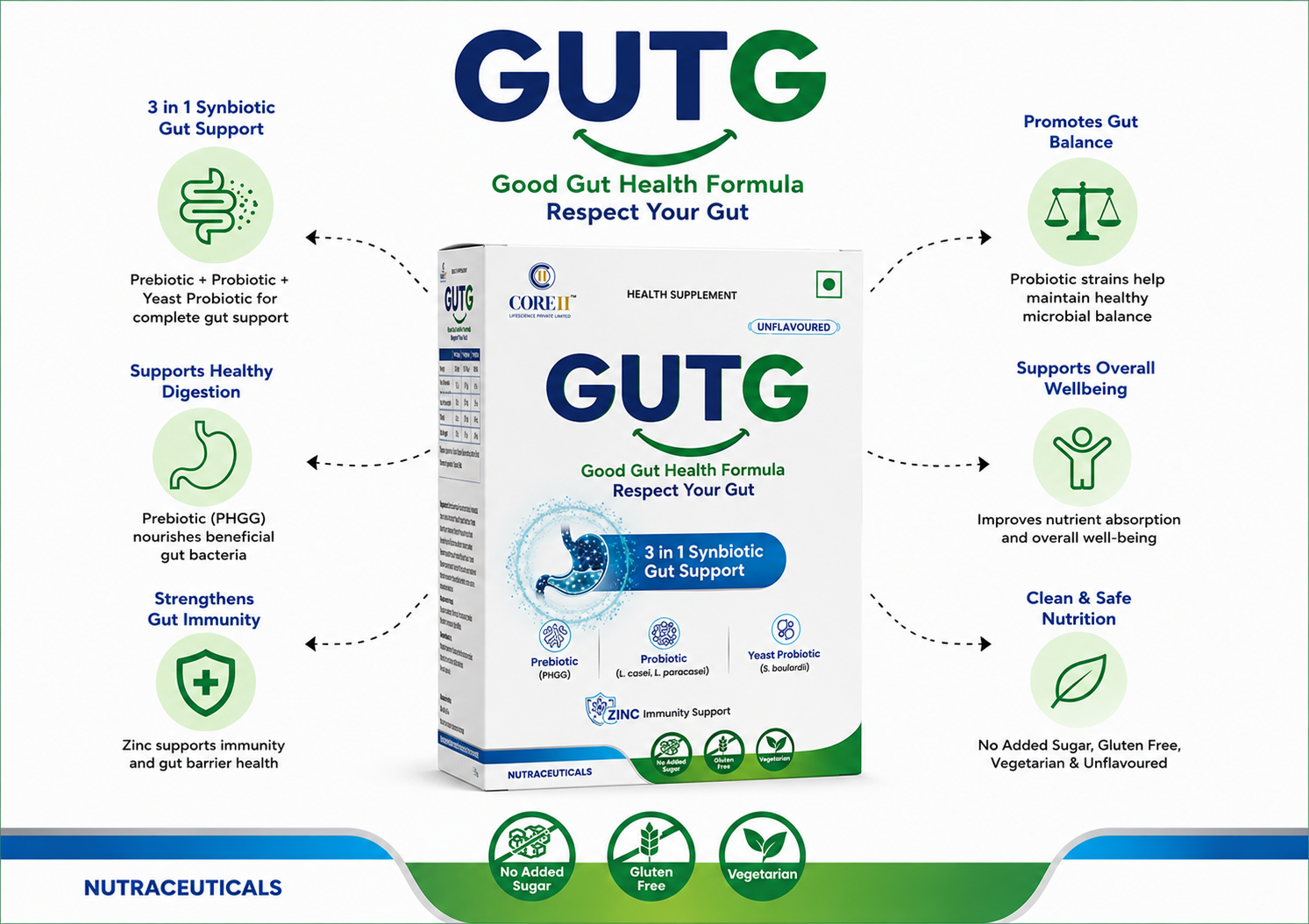
GUT G
Your gut does much more than digest food—it plays a vital role in digestion, immunity, metabolism, nutrient absorption, and overall well-being.¹–³
GutG is a scientifically formulated 3-in-1 Synbiotic Gut Support Formula combining PHGG prebiotic fiber, clinically studied probiotics, and zinc to nourish your gut microbiome and support everyday digestive wellness.⁴–⁸
Whether you're dealing with irregular bowel habits, low dietary fiber intake, bloating, or simply looking to improve gut health, GutG helps support a healthy digestive ecosystem.⁴–⁷
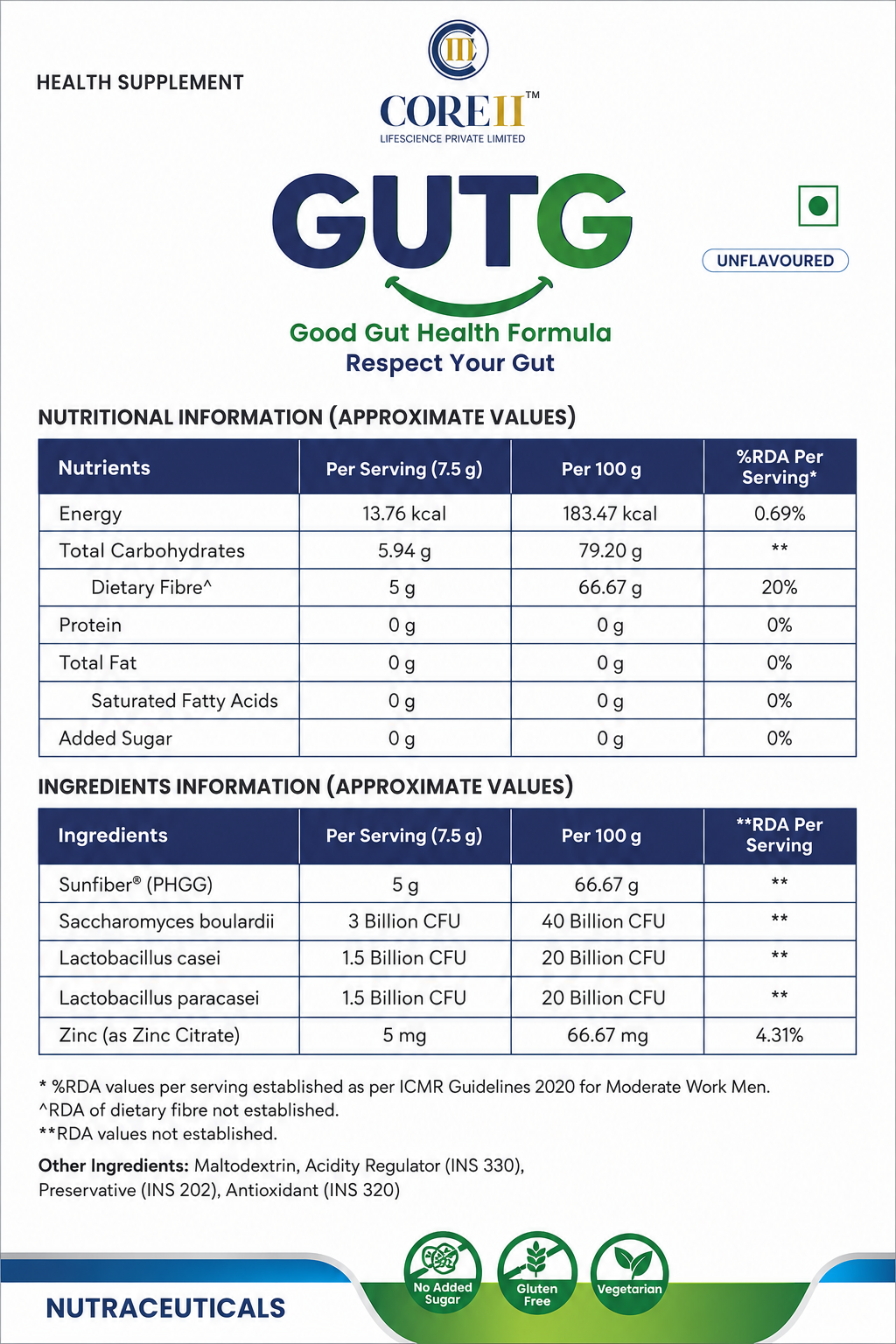
Sunfiber® (PHGG), Saccharomyces boulardii, Lactobacillus casei, Lactobacillus paracasei, Zinc Citrate
Modern lifestyles, processed foods, stress, antibiotics, and inadequate dietary fiber can negatively influence gut microbial diversity and digestive health.¹,³,⁹
GutG is designed to bridge this nutritional gap by providing:
• 5 g Sunfiber® (PHGG) soluble fiber
• 3 Billion CFU clinically selected probiotics
• Zinc for immune support
• Unflavoured & easy to mix
• Suitable for daily use
One sachet daily helps nourish your gut from within.⁴–⁸
Normal immune function¹³
• Protection of cells from oxidative stress¹³
• Healthy metabolism¹³
Sunfiber® (PHGG)
Provides 5 g soluble dietary fiber per serving.
Benefits include:
• Supports bowel regularity⁴,¹⁰
• Nourishes beneficial gut bacteria⁴
• Helps maintain digestive comfort¹⁰
• Gentle on the digestive system¹¹
Saccharomyces boulardii
A clinically studied probiotic yeast that supports intestinal microbial balance and digestive health.⁵
Lactobacillus casei
Helps maintain healthy intestinal flora and supports digestive wellness.⁶
Lactobacillus paracasei
Works synergistically with other probiotics to support a balanced gut microbiome and healthy immune response.⁷
Zinc Citrate
Provides zinc, an essential mineral contributing to:
• Normal immune function¹³
• Cell protection¹³
• Normal metabolism¹³
1. Empty one sachet into a glass.
2. Add approximately 200 mL water.
3. Stir until completely dissolved.
4. Consume immediately.
Recommended Usage:
One sachet daily or as directed by your healthcare professional.
.
Each sachet provides:
• Dietary Fiber (PHGG) – 5 g
• Saccharomyces boulardii – 3 Billion CFU
• Lactobacillus casei – 1.5 Billion CFU
• Lactobacillus paracasei – 1.5 Billion CFU
• Zinc Citrate – 5 mg
• Energy – 13.76 kcal
.
1. Valdes AM, Walter J, Segal E, Spector TD. Role of the gut microbiota in nutrition and health. BMJ. 2018;361:k2179.
2. Thursby E, Juge N. Introduction to the human gut microbiota. Biochem J. 2017;474(11):1823-36.
3. Fan Y, Pedersen O. Gut microbiota in human metabolic health and disease. Nat Rev Microbiol. 2021;19(1):55-71.
4. Slavin JL. Dietary fiber and body weight. Nutrition. 2005;21(3):411-8.
5. McFarland LV. Systematic review and meta-analysis of Saccharomyces boulardii in adult patients. World J Gastroenterol. 2010;16(18):2202-22.
6. Hill C, Guarner F, Reid G, et al. Expert consensus document: The International Scientific Association for Probiotics and Prebiotics consensus statement on the scope and appropriate use of probiotics. Nat Rev Gastroenterol Hepatol. 2014;11(8):506-14.
7. Sanders ME, Merenstein DJ, Reid G, Gibson GR, Rastall RA. Probiotics and prebiotics in intestinal health and disease. Nat Rev Gastroenterol Hepatol. 2019;16(10):605-16.
8. Gibson GR, Hutkins R, Sanders ME, et al. Expert consensus document: ISAPP consensus statement on the definition and scope of prebiotics. Nat Rev Gastroenterol Hepatol. 2017;14(8):491-502.
9. Sonnenburg ED, Sonnenburg JL. The ancestral and industrialized gut microbiota and implications for human health. Nat Rev Microbiol. 2019;17(6):383-90.
10. Giannini EG, Mansi C, Dulbecco P, Savarino V. Role of partially hydrolyzed guar gum in the treatment of irritable bowel syndrome and constipation. Nutrients. 2021;13(10):3621.
11. Takahashi H, Yang SI, Hayashi C, et al. Influence of partially hydrolyzed guar gum on human intestinal microbiota and bowel function. J Nutr Sci Vitaminol (Tokyo). 1994;40(3):251-9.
12. Plaza-Diaz J, Ruiz-Ojeda FJ, Gil-Campos M, Gil A. Mechanisms of action of probiotics. Adv Nutr. 2019;10(Suppl 1):S49-S66.
13. Institute of Medicine (US). Dietary Reference Intakes for Vitamin A, Vitamin K, Arsenic, Boron, Chromium, Copper, Iodine, Iron, Manganese, Molybdenum, Nickel, Silicon, Vanadium, and Zinc. Washington (DC): National Academies Press; 2001.